
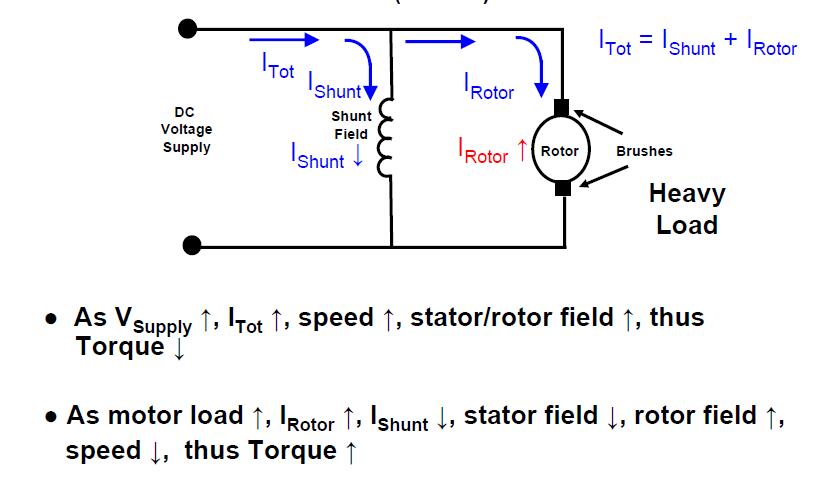
Shunt-Wound
(SHWDC)
● Decreasing torque at high speed
● At low speed, higher more consistent torque
● Excellent speed control
● Typically used in Industrial and automotive applications
● No loss of magnetism over time as with PMDC motors
● More expensive than PMDC motors
● Motor Runaway, if the shunt current goes to zero
Shunt-wound brushed DC motors have the performance characteristics of decreasing torque at high speeds and a high but more consistent torque at low speeds. The current in the field coil and in the rotor are independent of one another, thus, the total current of the motor is equal to the sum of the shunt current ( or stator current ) and the rotor current. As a result, these motors have excellent speed control characteristics. Shunt-wound brushed DC motors are typically used in applications that require 5 or more HP such as industrial and automotive applications. As compared to permanent magnet brushed DC motors, shunt wound brushed DC motors have no loss of magnetism and are more robust. Some drawbacks are that shunt wound brushed DC motors are more expensive than permanent magnet brushed DC motors and have the potential of motor runaway if the shunt current decreases to zero. This is a very dangerous condition that can lead the motor to literally brake apart.
Contact: Sammy
Skype:
Tel:
Email: sammyfu@electricmotorscn.com
Add: Building 3, No. 2 Chaoheng Road, Chashan Town, Dongguan City, Guangdong Province
 Sammy
Sammy