DC Motor Driver Fundamentals
Electric motors have been with us since the early 19th century, when Hungarian physicist Ányos Jedlik produced the first continuously rotating DC motor, made possible by his invention of the commutator. By the early 20th century electric motors revolutionized industry and agriculture and made possible such labor saving consumer applications as washing machines and refrigerators. Today electric motors power everything from giant cruise ships to implantable
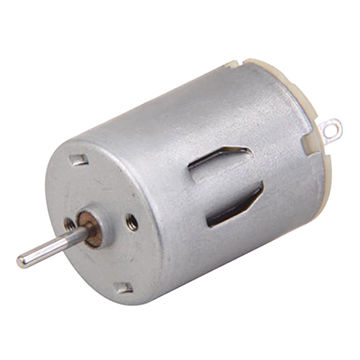
medical devices. There are many different types of motors, but they all contain three basic elements: an armature, a field magnet, and a commutator. The armature is a conductive coil that in most cases is attached to a rotating shaft and surrounded by a field magnet, which can be either a field winding or permanent magnets. Current passing through the armature creates a magnetic field that is opposed to the field current, resulting in an electromotive force (EMF) that causes the shaft to rotate, generating mechanical torque. The commutator is a set of contacts attached to the armature shaft that keeps reversing the direction of current flow in the armature as it turns, thus ensuring that the motor continues to turn.
While motors are mechanically rather simple, the terms that describe them can be confusing. In mechanical terms the rotating part of motor is called the rotor; the stationary part is the stator. In electrical terms the power producing part of the motor is called the armature; depending on the design the armature can be either the rotor or the stator. The
field is a magnetic field component of the motor; again this can be either the rotor or the stator and it can be either an
electromagnet or a permanent magnet. In general literature these terms are often used interchangeably, which can be
confusing.

 Sammy
Sammy