THE FUNDAMENTALS OF AC ELECTRIC INDUCTION MOTOR DESIGN AND APPLICATION-page1
ABSTRACT
The conversion of electrical energy into mechanical energy has been and continues to be a dominant form of power transmission for industrial purposes. The alternating current (AC) electric induction motor has been an industry workhorse for electro-mechanical conversion for over 100 years. This tutorial will introduce the user to the fundamental electrical and mechanical principles of AC electric induction motor design and application.Specific emphasis will be given to pump applications.
INTRODUCTION
Electromechanical energy conversion involves the interchange of energy between an electrical system and a mechanical system through the medium of a coupling magnetic field. When the conversion takes place from electrical to mechanical form,the device is called a motor. The primary quantities involved in the electrical system are voltage (E) and current (I),while the analogous quantities in the mechanical system are torque (T) and espectively. Figure 1 shows a block representation of this energy conversion for motor action.
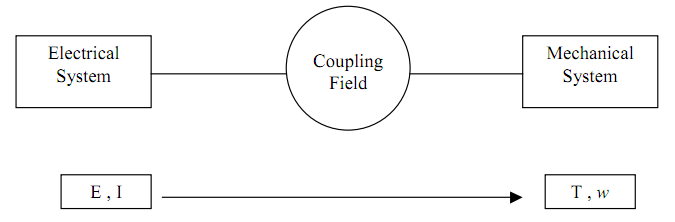
igure 1. Block Representation of Energy Conversion for Motors.
The coupling magnetic field is key to the operation of electrical apparatus such as induction motors. The fundamental laws associated with the relationship between electricity and magnetism were derived from experiments conducted by several key scientists in the 1800s.
Basic Design and Theory of Operation
The alternating current (AC) induction motor is one of the most rugged and most widely used machines in industry. There are two major components of an AC induction motor. The stationary or static component is the stator. The rotating component is the rotor.The stator is composed of laminations of high-grade sheet steel.The inner surface is slotted to accommodate windings. In Figure 2 a three-phase winding is represented by the three coils,the axes of which are 120 electrical degrees apart.
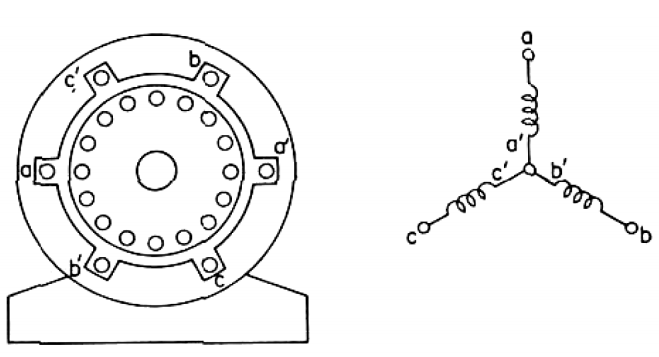
igure 2. Three-Phase Induction Motor Showing Stator,Rotor,and Schematic Representation of Y-Connected Stator Winding.
Coil aa represents all the coils assigned to phase a for one pair of poles. Similarly coil
bb represents phase b coils,and cc represents phase c coils. When one end of each phase is commonly connected,as shown in Figure 2,the three-phase winding is said to be Y-connected. Such a winding is called a three-phase winding because the voltages induced in each of the three phases by a

 Sammy
Sammy